
I'm the keynote they book when the last one got a standing ovation and changed nothing.
I expose the hidden patterns beneath performance — especially the financial pressure quietly shaping how people lead, decide, sell and perform.
For conference producers and business leaders who want the room changed, not merely entertained.
I'm the keynote they book when the last one got a standing ovation and changed nothing.

I expose the hidden patterns beneath performance — especially the financial pressure quietly shaping how people lead, decide, sell and perform.
For conference producers and business leaders who want the room changed, not merely entertained.
I'm the keynote they book when the last one got a standing ovation and changed nothing.
I expose the hidden patterns beneath performance — especially the financial pressure quietly shaping how people lead, decide, sell and perform.
For conference producers and business leaders who want the room changed, not merely entertained.
Nobody remembers the coffee cart.
They remember the hour that didn’t work.
You’re carrying the theme, the run sheet, the sponsors, the room, the person above you who wants to know why this speaker — and the quiet fear nobody puts in the brief:
What if you do everything right and the room still doesn’t move?
Most event problems are recoverable.
The coffee arrives late.
The lanyards are wrong.
The stage lights develop a personality.
Annoying. Fixable. Forgotten by Friday.
The speaker isn’t like that.
Read the room wrong, give them something they’ve heard twelve times before, or leave the audience wondering what the point was — and that becomes the line in the feedback forms.
So you’re not really shortlisting a speaker.
You’re deciding who you trust with the part of the program people will still be talking about afterwards.
NOT A TOPIC. A WAY OF SEEING WHAT’S ALREADY IN THE ROOM.
The Undercurrent™
The Undercurrent™ is the private pressure running underneath visible performance.
The same pressure wears different clothes in different rooms:
In a workforce, it looks like distraction, silence and avoidable error.
In leadership, it changes judgement.
In sales, it shows up at the exact moment someone has to name their value.

Every room has pressure running underneath it.
Private numbers.
Old beliefs.
Decisions being made with more sitting behind them than the dashboard can see.
The Undercurrent™ is the layer where that private pressure becomes visible performance.
It gives the room language for something people can often feel but haven’t known how to name — without turning the session into a finance lecture, a therapy session or a public disclosure exercise.
The Work Has Three Movements
Reveal
See the pattern.
Repair
Interrupt what the pattern has been driving.
Reclaim
Choose what happens next.
ORIGIN Of THE UNDERCURRENT:
This didn't start with a TEDx clip and a theory about human potential.
(No firewalking. Promise.)
It started inside the banks funding airports, coal mines, shopping centres and windfarms — where pressure wasn’t theoretical. It showed up in risk, judgement, decisions and the numbers on the board.
Three keynotes. One Undercurrent™.
Same body of work underneath. Three different ways into the room.
Tell me what your event needs to achieve, and I’ll tell you which one gets you there.
01
Keynote 1:
The Hidden Patterns Beneath Performance
Why financial pressure is quietly changing how your people lead, decide and perform.
The signature keynote · 45 minutes + 15 minutes Q&A.
Financial pressure rarely announces itself as financial pressure.
It shows up somewhere else — in distraction, hesitation, judgement, communication, the decision somebody second-guesses or the one they make too quickly.
This is the keynote that names the pattern.
BUILT FOR
Conference main stages, leadership events, people-and-culture programs, resources, infrastructure, government, financial services and mixed corporate audiences.
Your room leaves with:
A clearer view of how hidden pressure can surface in workplace behaviour — including in people who appear completely fine.
Language for a conversation people often have privately but rarely know how to have at work.
Reveal, Repair, Reclaim — a simple framework for recognising the pattern and deciding what to do with it next.
01
02

KEYNOTE 2:
Private Pressure, Public Consequences
How financial stress travels from the kitchen table to the risk register.
The systems keynote · 45 minutes + 15 minutes Q&A.
Also available as a deeper executive briefing - through Consulting
What begins at one kitchen table does not necessarily stay there.
Private pressure can travel through attention, judgement, leadership behaviour and team climate — until an apparently personal issue has become a performance, capability or psychosocial-risk consideration.
The micro rolls up to the macro.
This keynote traces the route.
BUILT FOR
P&C, WHS and HSE leaders; executive and board sponsors; government, local government, infrastructure and safety conferences.
Your room leaves with:
A line of sight from private pressure to workforce capability, culture and organisational exposure.
A clear explanation of why financial pressure can act as a driver and amplifier of psychosocial risk, rather than pretending it is itself a listed hazard.
A better understanding of why downstream support such as EAPs matters — but cannot do the whole job alone.
03

Keynote 3:
The Value You Leave on the Table
Why your best salespeople can know exactly what to say and still leave money on the table.
The commercial keynote · 45 minutes + 15 minutes Q&A.
Your best performers know how to close.
So why do capable people sometimes hesitate at the number, discount before anyone asks, or hand back margin they were never required to give?
Sometimes it isn’t a skills gap.
It is the belief sitting underneath the ask.
BUILT FOR
CROs, heads of sales, sales enablement leaders, franchise and agency principals, commercial teams and producers who have had enough of rah-rah.
Your room leaves with:
The Worth Line — the quiet belief about what a person is allowed to have, running underneath the ask.
A different way to diagnose the gap between what someone could charge and what they actually do.
A pattern to recognise before the next negotiation, rather than only in the debrief afterwards.
03
Your people get one thing.
You get another.
The Room Leaves With More Than Just a Good Hour:

The pattern named
Something that has been running privately becomes visible enough to understand — without anybody being singled out.
The room leaves with more than just a good hour:
The pattern named
Something that has been running privately becomes visible enough to understand — without anybody being singled out.
Language they can actually use
Not a vocabulary lesson. A few sturdy ideas people can recognise in themselves and use in conversations afterwards.
Recognition, not instruction.
Nobody gets told what to do with their money. They see what pressure can do to behaviour and decision-making — and what to notice next.
Plus, You Get:
A session with a reason to be on the program.
Distinct enough to stand apart from another generic wellbeing or resilience hour, and clear enough to explain to the committee that signs off.
Something that continues after the applause.
The session ends. The language gives the conversation somewhere to go.
The “where did you find her?” credit.
Not because the session shouted the loudest. Because it named something the room hadn’t heard put that way before.
"And that is what makes Tara Saxon a safe pair of hands.
"And that's what makes Tara a safe pair of hands:
Her content, her speech, will leave an indelible imprint.
But more importantly, she will do whatever it takes to deliver on her promise."
But more importantly, she will do whatever it takes to deliver on her promise."
JACQUELINE BROOKER - EVENT ORGANISER
"She challenged how I think, and what I would do into the future. Tara delivered this message in a way that was accessible and actionable"
"She challenged how I think, and what I would do into the future. Tara delivered this message in a way that was accessible and actionable."
LEON PURTON - AUDIENCE MEMBER, MAINSTAGE KEYNOTE






What It Looks Like to Work Together
FROM FIRST ENQUIRY TO THE LAST ROW LEANING IN
THE BRIEF
Here's where you tell me:
What the event has to achieve
Who's in the room
What's already been tried
You don't need the final brief yet.
THE BUILD
I do the homework before I go anywhere near the stage.
Your sector
Your audience
Your language
Your pressure points
THE ROOM
This is where:
The pattern gets named.
The room gets language for it.
The conversation has somewhere to go.
YOU BRIEF ME ONCE. THE REST IS MINE.
No generic deck.
No chasing.
No last-minute surprises.

HERE’S THE THING —
This is not a finance talk.
Nobody is leaving with a spreadsheet.
Nobody is being sold a financial product.
Nobody is asked to disclose their balance, debts, or income to anyone in the room.
And nobody is getting a lecture about “better money habits”.
I talk about the patterns around financial pressure — how they affect judgement, behaviour and performance — in a way that lets people recognise themselves without being exposed by the experience.
The work is trauma-informed, commercially grounded and built for mixed rooms.
People feel seen. Nobody gets exposed.
That’s the point.
HERE’S WHO YOU’RE HANDING THE ROOM TO:
Most speakers pick a lane. The numbers or the feelings.
I spent two decades learning they were never two.
Before the stage came banking and project finance — Arthur Andersen, NAB, BankWest, American Express and the HSBC–Woolworths joint venture.
Risk. Funding. Commercial decisions. International B2B. The number on the board and the deal that closed — or didn’t.
Then came the other literacy: behavioural change, coaching and trauma-informed practice.
That combination matters because this work sits exactly where the commercial system and the human one meet.
I can read the number. And I can read what may be sitting underneath it.
That is what puts both boardroom credibility and a human read into the same room.
You don’t fix a bowing wall by repainting it.

The questions sensible people ask before they put someone on stage:
Is this a financial literacy session?
No.
Nobody gets taught budgeting, super, insurance or financial products.
This is a performance and behaviour conversation about what financial pressure can do to the way people lead, decide and perform.
There are excellent people who teach financial literacy.
I’m not one of them.
Do you only speak to women?
No.
My organisational audiences are mixed, and many are heavily male — operations, utilities, resources, infrastructure and local government.
The mechanism is not gender-specific.
Can you tailor the keynote to our industry?
Yes — but not by changing the logo on slide one.
The core thinking stays intact.
What changes is the world around it: your sector, workforce, current pressures, audience mix, language, data and examples.
The framework is consistent. The context is yours.
Do you travel?
Yes — nationally and internationally.
Travel and accommodation are itemised separately in the proposal so there are no surprises.
Will it land with a mixed room?
That is the room I build for.
Crews and executives. Technical and non-technical. People at the beginning of their careers and people looking at retirement.
Nobody needs prior financial knowledge, and nobody gets talked down to.
Is the topic too sensitive for a workplace audience?
The sensitivity is part of the design.
Nobody is asked to disclose their financial situation, share personal details or identify themselves publicly as struggling.
People can recognise what matters to them without explaining to the room why it matters.
What if someone in the room is genuinely struggling?
The session is designed to open the topic safely and close it properly.
Nobody is singled out and no exercise puts an individual on the spot.
Where the organisation has appropriate support pathways, those can be referenced.
How long do you need?
The signature keynote is 45 minutes plus 15 minutes for questions.
If the run sheet says something different, tell me what you’re working with and we’ll see what fits without gutting the session.
The applause lasts a minute.
What people recognise in themselves afterwards lasts considerably longer.
If hidden pressure is already shaping how people lead, decide or perform, leaving it unnamed does not make it neutral.
It simply leaves the pattern running.
Put it in the room.
Name it properly.
Give people language for what happens next.
Tell me what you're planning.
You don’t need the final brief, date or budget to start. Come early. Come vague.
NOT READY TO PUT IT ON STAGE YET?
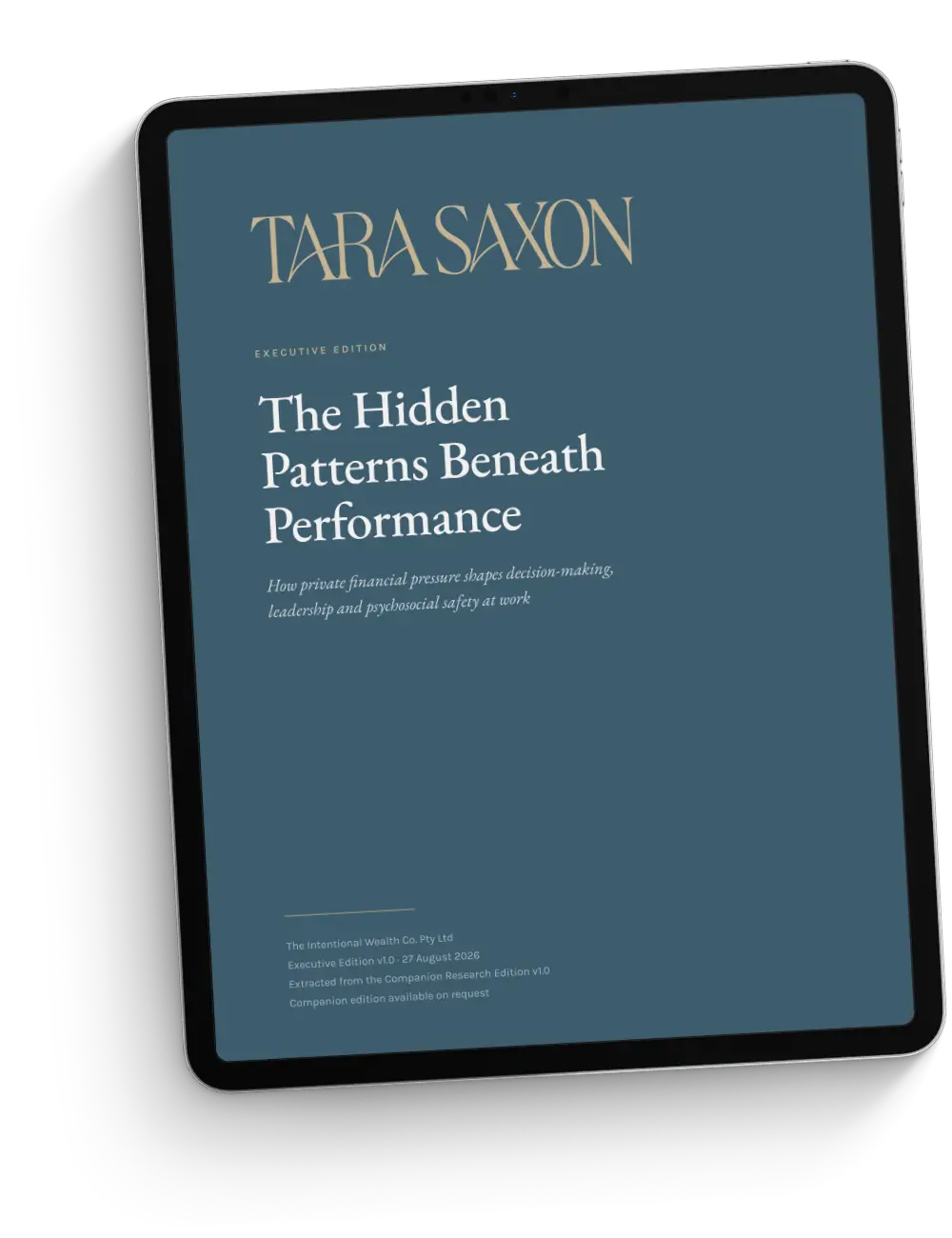
Start with the evidence.
The Research Brief lays out the pattern, the research and what hidden financial pressure may be changing inside an organisation.
Useful for you.
Even more useful when someone else needs convincing.
Put it in the room.
Name it properly.
Give people language for what happens next.
Tell me what you're planning.

Hidden pressure shapes visible performance.
Here for personal money coaching?
That lives at certifiedmoneycoach.com →
P.S. You devoured the whole page. That kind of tenacity? We'd get along.
Tara's work addresses the human side of financial pressure - behaviour, patterns, and performance.
It's education, not financial advice: no products, no recommendations, no exceptions. For personal financial advice, talk to a licensed professional.