
PsychoSocial Safety & FINANCIAL PRESSURE
Financial pressure drives psychosocial risk.
Nobody's ever owned it.
Which is why nobody's ever measured it properly.
Financial pressure drives psychosocial risk.
Nobody's ever owned it.
Which is why nobody's ever measured it properly.

Your register covers the things you were given instruments for. Workload. Bullying. Role clarity. Fatigue. Poor support. Every one of them measurable, every one somebody's responsibility.
Then there’s the pressure people carry through the gate every morning — pressure that changes how they lead, decide and perform, but rarely appears on the register under its own name.
Not because anyone decided it didn't matter. Because it fell between two professions, and neither one came back for it.
WHY NO ONE HAS NAMED IT
You are not behind on this.
There has been nothing to be behind on.
Financial pressure has traditionally lived in one world. Psychosocial safety in another.
Financial services focused on the individual. WHS and wellbeing focused on workplace hazards, support and controls. What neither was designed to examine was what private financial pressure does to workplace behaviour.So it rarely appears under its own name in the instruments, codes and reporting systems organisations already use.
And to be clear about what this is not: it isn't financial literacy, and it isn't budgeting. Nobody in your organisation gets asked what they earn, what they owe or what they spend. Your people are treated as intelligent adults carrying something they didn't ask for.
START HERE IF YOU WANT PRACTICAL HELP
Three tools sit at the bottom of this page. All free. One sizes the problem, one prices it inside your organisation, one tells you where you personally sit.
If that's what you came for, skip ahead.

WHAT CHANGED ON 1 JULY
What has changed is the standard you're held to.
Since 1 July 2026 in New South Wales, approved Codes of Practice — including Managing psychosocial hazards at work — carry comply-or-justify status under section 26A of the WHS Act.* Which means the question is no longer whether you followed the code. It's whether you can demonstrate an equivalent or better standard if you didn't.
SafeWork NSW now has twenty inspectors dedicated to psychosocial safety, and has named psychosocial risks one of four key priority areas for 2026-27.†
That's New South Wales. Other jurisdictions are heading the same way and haven't arrived, and I won't tell you otherwise.
What it means practically is that officer duty here is personal and cannot simply be delegated away. And if you choose a different approach from an approved Code, you need to be able to demonstrate an equivalent or higher standard of health and safety.
“We were getting to it” has stopped being a position that holds comfortably.
* NSW Work Health and Safety Act 2011, s 26A, effective 1 July 2026.
† SafeWork NSW 2026-27 Regulatory Statement, 1 July 2026.
WHY IT BELONGS ON THE REGISTeR YOU ALREADY KEEP
Start with the hazards you do manage.
High job demand. Low control. Poor support. Bullying. Role conflict. Every one of them recognised, assessed and controlled. And any one of them becomes harder to manage for a person who arrives at work already depleted.
The employee with nothing left in reserve doesn't experience high job demand the way her colleague does. The one lying awake over a mortgage doesn't absorb a difficult manager the same way. Low control at work is one thing when the rest of life is stable. It can feel very different when it isn't.
Financial pressure doesn't need to be on your register to be changing what's already on it. It's a driver and an amplifier — a force multiplier sitting underneath hazards you've already assessed, quietly changing how effective those controls are in practice.
And the Code is worth reading closely on this. SafeWork NSW's approach prioritises higher-order controls where reasonably practicable — redesigning workloads, reallocating resources, clarifying reporting lines, improving consultation. It states plainly that these will generally be more effective than relying solely on training, employee assistance programs or complaint procedures after problems occur.*
That's the regulator's ranking, not mine. Your EAP is a lower-order control — not a failure, but a control that acts after the fact, on the people who reach for it. The Code asks what you did before that.
* NSW Code of Practice: Managing psychosocial hazards at work.
That's the interaction. Here's the part that explains why nobody has named it yet.
Australian workplace safety has moved in waves.
01
Physical safety came first.
Forty years of it. Hard hats, guarding, lock-out tag-out, the right to refuse unsafe work. People go home who wouldn't have. That work was fought for, in rooms that didn't want to have the conversation, by people who kept having it anyway.
02
Mental health came second.
Later, harder, and against more resistance. Talking about psychological wellbeing on a mine site or a construction crew was unthinkable within living memory. It is now ordinary. That shift happened because the first wave had already established that what happens to a worker's body is the employer's business — which made it possible to ask about the mind.
03
Psychosocial safety is the third wave.
And it is only sayable because the first two made it sayable. Physical safety established that the employer has a duty. Mental health established that the duty extends past the visible. This is the next layer down, and it arrives on ground the work before it prepared. Financial pressure matters here because of the intensity it adds into the mix.
This isn't a prediction.
SafeWork NSW's 2026-27 priorities list psychosocial risks alongside falls from heights and mobile plant. The third wave isn't coming. It's on the same page as the hard hats.
None of the earlier waves were wrong or incomplete. Each widened what workplace safety was prepared to look at.
That’s why this conversation is possible now.
NODDING ALONG?
If any of these sound like you, start here.
I think this is showing up in our numbers. I can't put my finger on where.
Someone's going to ask me how big it is, and I don't have an answer.
If we were audited on this tomorrow, I couldn't show what we've looked at.
I know it matters. I don't know what I'd even ask for.
… then one of these three will get you further than another meeting will.
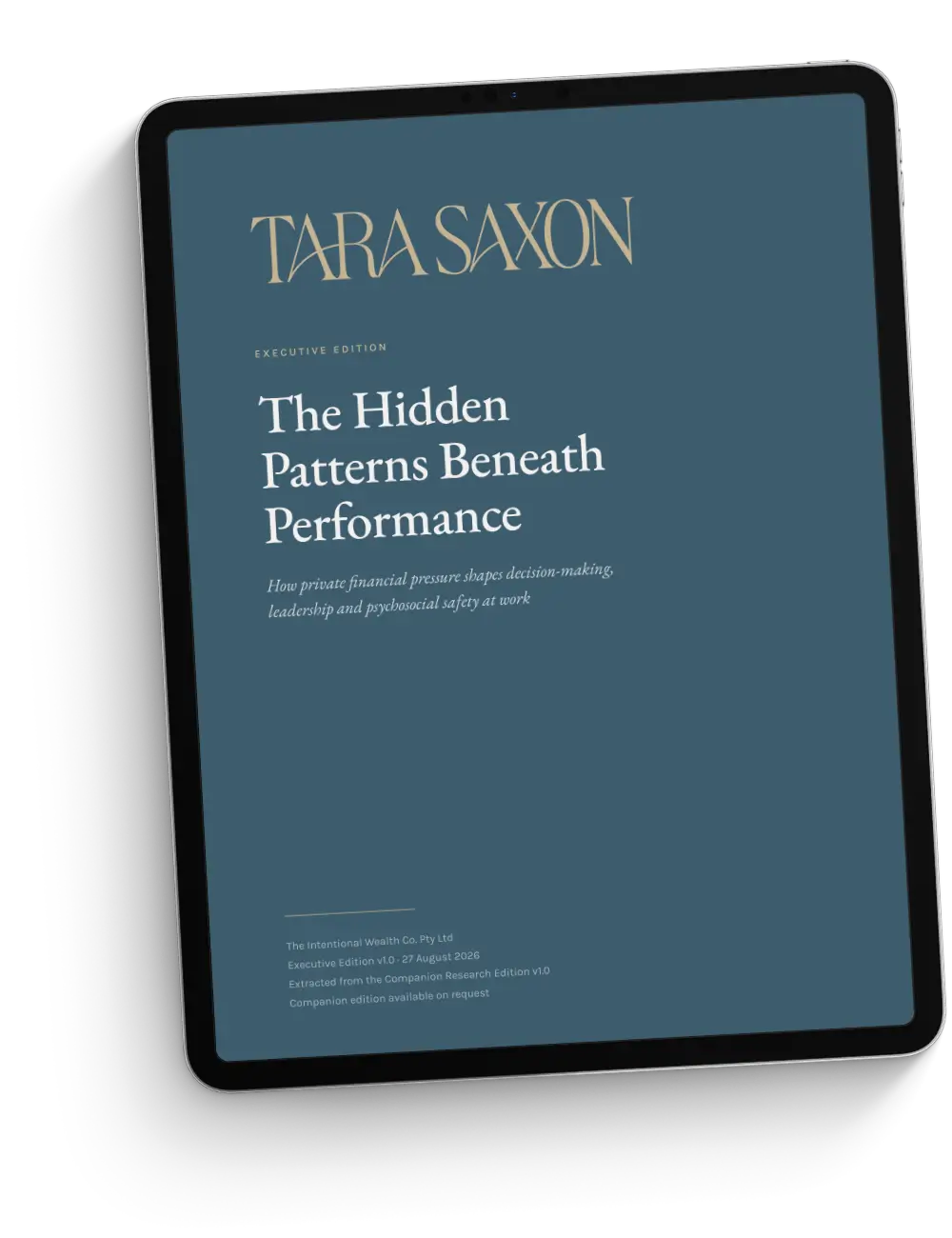
THE RESEARCH BRIEF
The Hidden Patterns Beneath Performance
How big is this — really?
The research behind financial pressure and workplace behaviour, in Australia and internationally. Every figure sourced, every limitation stated, and written to be forwarded to whoever needs convincing.
Free · About twenty minutes
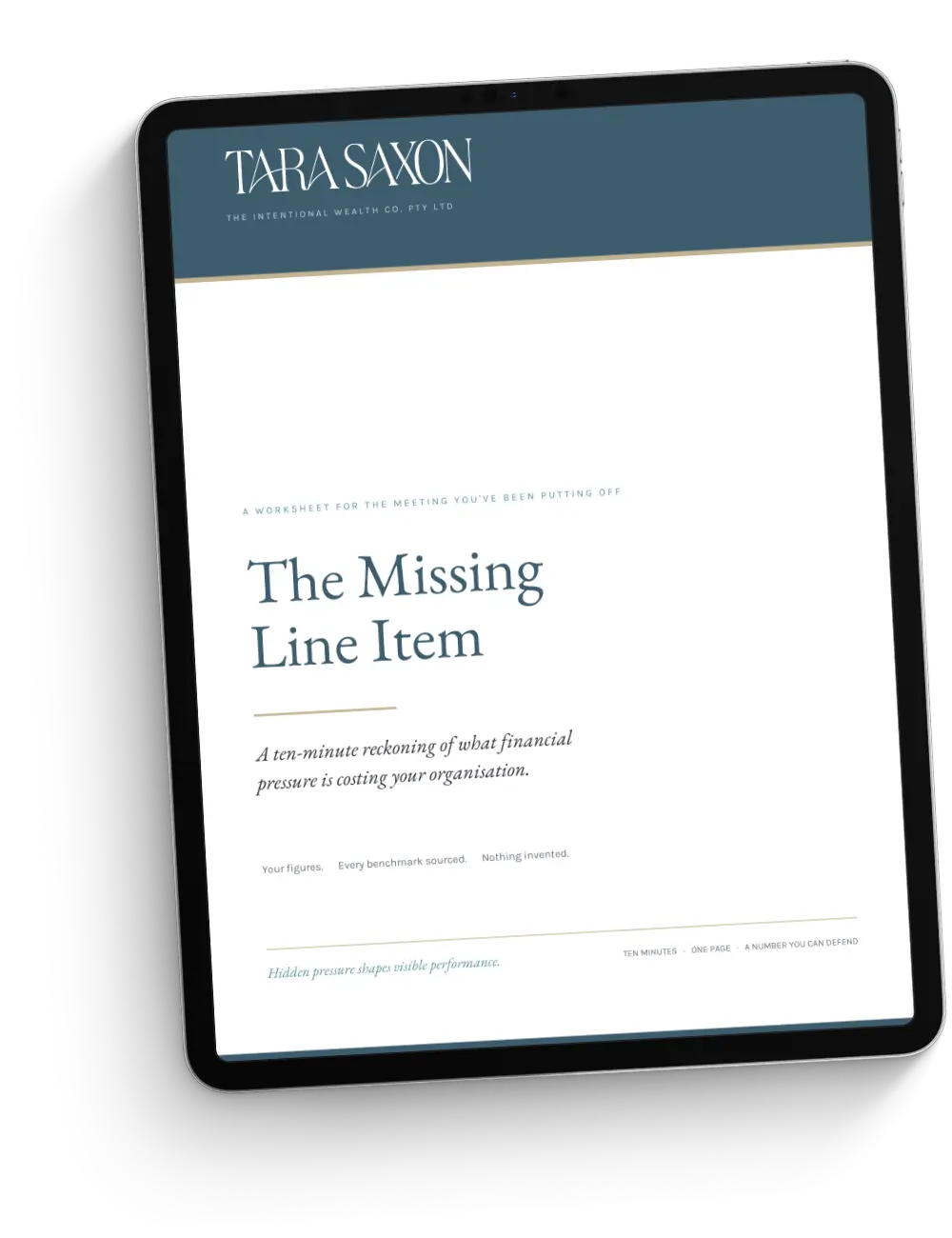
THE MISSING LINE ITEM
A One-page
Ledger
What might it be costing your organisation?
Put a figure against the pressure using your headcount, your numbers and your arithmetic. It stays on your desk. Ten minutes, and you’ll have something useful to take into the room.
Free · Ten minutes
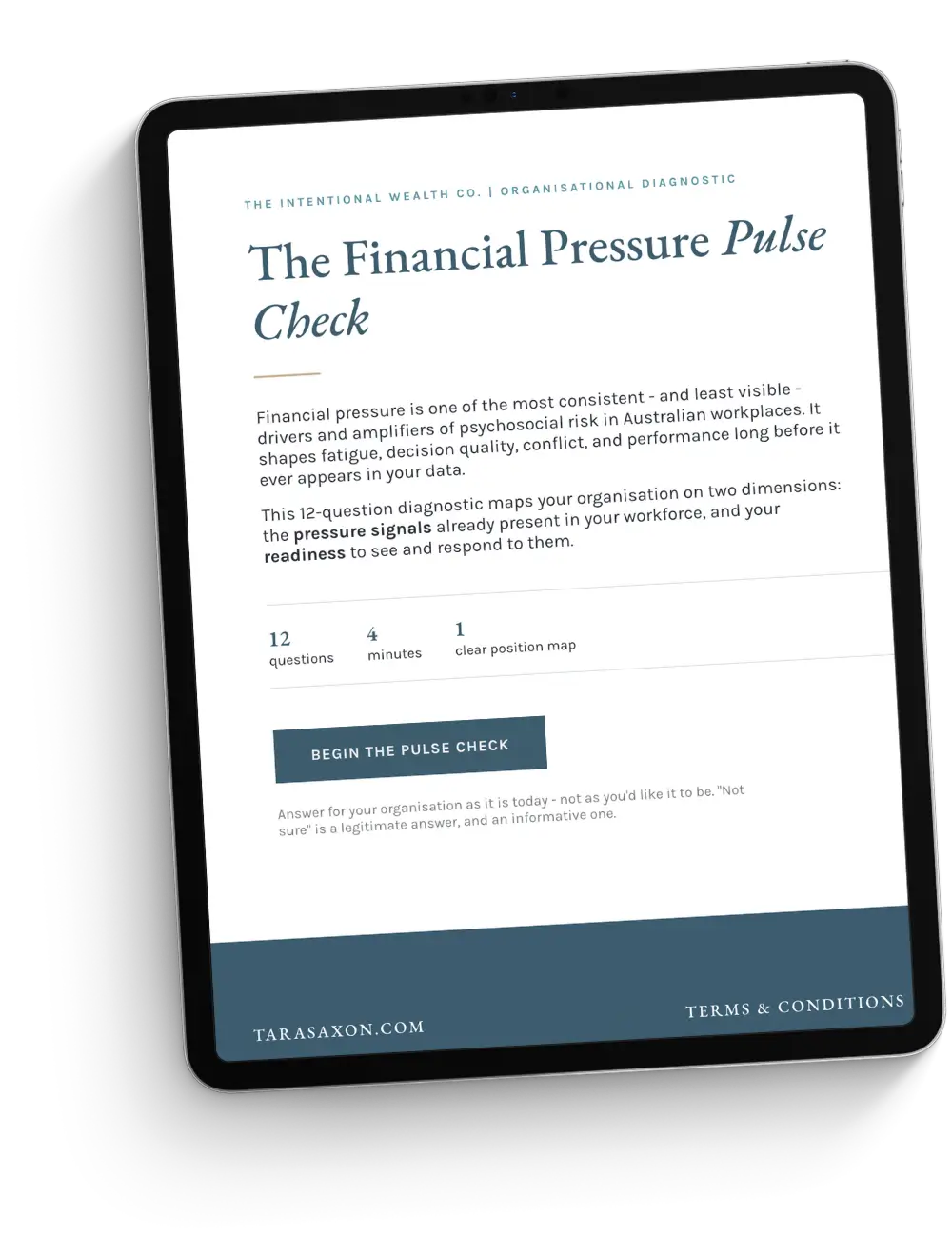
THE PULSE CHECK
Where
You Sit
What are you bringing with you into the room?
Before you assess an organisation, it’s worth knowing your own starting point. Four minutes, honest questions, results emailed to you and nobody else.
Free · Four minutes
$1,887
Per employee, per year. The productivity gap between a poor and a strong psychosocial safety climate.*
12+
Productive hours lost every week by an Australian under financial stress. Nearly eleven to presenteeism.**
26 of 26
Said financial pressure affected wellbeing in one Australian operations room. Nobody said no.***
$0
What it costs to stop guessing.
*$1,887: Becher & Dollard for Safe Work Australia, 2016 — still the most recent Australian estimate of its kind.
**Hours lost: AMP Financial Wellness Report 2022.
***Room evidence: Australian operations and utilities workforce session, 2026, 19 definitely · 7 sometimes · n=26.
where this has already
been in the room

"The most impactful HR-driven initiative we've implemented in living memory."
HR Manager,
Local Government NSW
"Tara has this rare ability to make you feel seen without making you feel exposed."
eric em,
Business Systems Technical Lead (Engineering Systems), Origin Energy






These questions have already been put to Australian workforces — operations floors, depots, council chambers, mine sites.
In one recent utilities and operations workshop, 32 of 37 participants said money was front of mind at least some of the time when they considered their own wellbeing.
That matters because what is front of mind privately does not stay neatly outside the workplace.
One room, thirty-seven people, and I'll always give you the denominator rather than a percentage.

why this sits with me
Two decades inside banking and commercial finance came before any of this — Arthur Andersen, NAB, BankWest, the HSBC-Woolworths joint venture and American Express, where I spent the longest stretch in international B2B. Risk. Funding. Contracts. Long-horizon investment. I know what a number has to survive before anyone acts on it.
B.Com · M.App.Fin · ICF Professional Certified Coach · Certified Money Coach (CMC®)
Most people working in this territory come from one side or the other: commercial or behavioural. This particular problem needs both — because the number tells you something has moved, and the behaviour tells you what.
That isn't a claim about being better than anyone. It's a claim about the gap. Financial pressure was handed to financial services. Psychosocial safety was handed to WHS and wellbeing. What happens where the two meet has too often disappeared between the systems already in the building.
I’ve been standing in that gap since 2008. Long enough to know it isn't going to close on its own.
if you'd rather talk it through
The tools will get you a long way on your own.
This is for the part you'd rather not put in writing yet.
Tell me what you're seeing — in your data, in your incident reports, in the exit interviews that keep saying nothing useful, or the event brief you’re trying to make sense of. I'll tell you plainly what I'd look at, what format makes sense, and whether I'm the right person for it.
If the answer is that you don't need me, I'll say so.
Twelve minutes. One business day. An honest answer.

Hidden pressure shapes visible performance.
Here for personal money coaching?
That lives at certifiedmoneycoach.com →
P.S. You devoured the whole page. That kind of tenacity? We'd get along.
Tara's work addresses the human side of financial pressure - behaviour, patterns, and performance.
It's education, not financial advice: no products, no recommendations, no exceptions. For personal financial advice, talk to a licensed professional.