Written to survive a sceptic. Especially the one who signs things off.
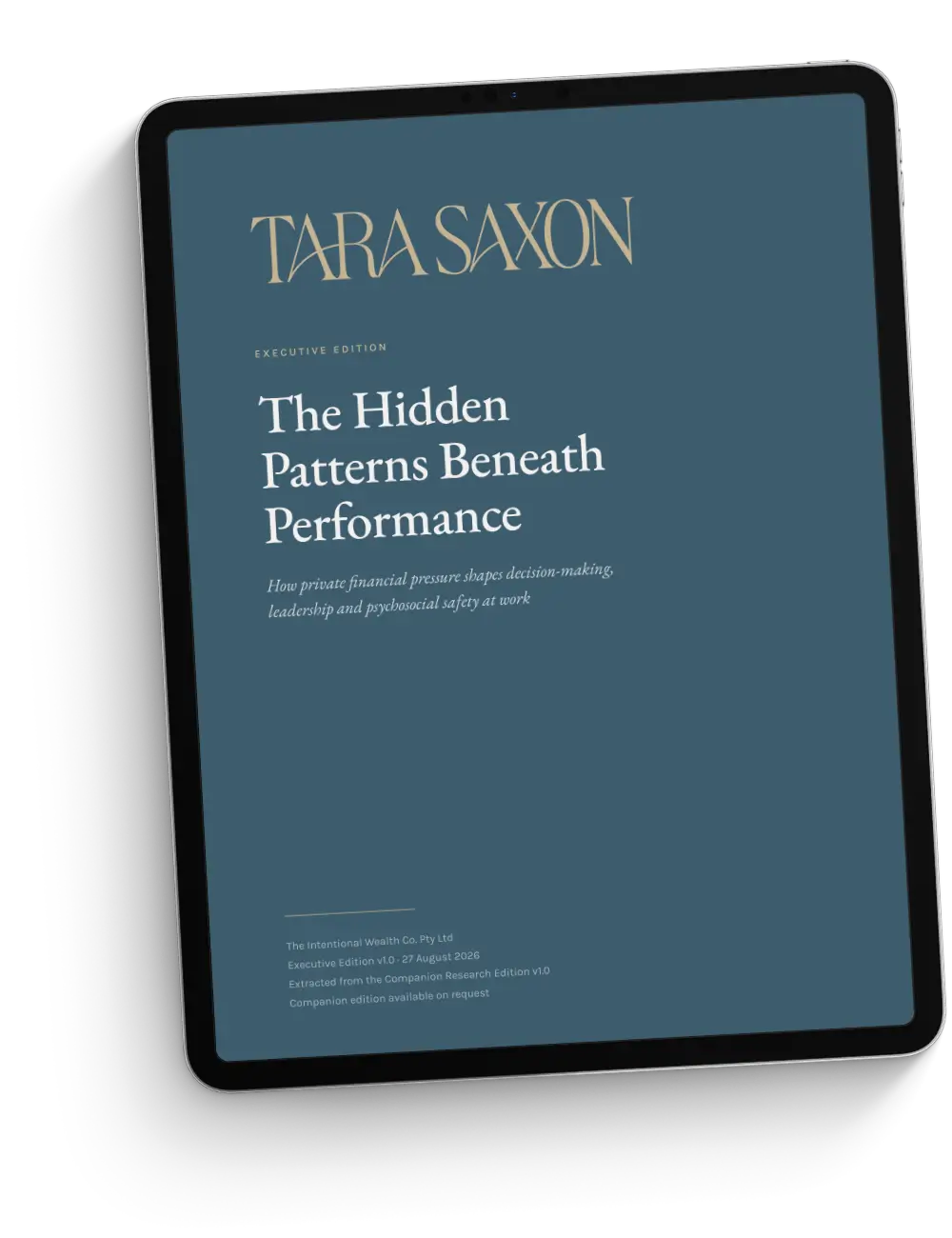
The research brief
You've been making this argument on instinct. Here's the version that argues back.
The Hidden Patterns Beneath Performance: how financial pressure moves through a workforce, why the people carrying it will never put it in a survey, and what it costs while it stays quiet.
Written for whoever has to answer for absenteeism, attrition, disengagement and psychosocial risk. Usually the same person. Usually alone.
Fully sourced · built to be forwarded · the evidence carries it, so you don't have to

Here's the part that surprises people.
Financial pressure isn't a pay grade. It's a pattern.
1 in 5 Australian employees is carrying moderate or severe financial stress*.
More than half of 2,793 UK resident doctors and medical students reported the same thing in a 2026 study - a profession nobody thinks to ask†.
7 in 10 US employees said theirs was rising‡.
Three continents, one shape
Then there's the finding that should bother you more than any of those numbers.
Every instrument you own for detecting this - the engagement survey, the exit interview, the absence report - relies on people telling you the truth about what they're carrying.
Around money, they won't. Your data isn't wrong. It's just a floor.
Our cultural taboo around money talk has seen to that.
* Australian employees in moderate or severe financial stress: AMP Financial Wellness Report 2022, n=2,013.
† UK resident doctors and medical students: British Journal of Psychiatry, 2026, n=2,793.
‡ US employees reporting increased financial stress: Mercer, Inside Employees' Minds. Fieldwork September–October 2025. US figure.

So the paper assembles what's known:
The prevalence, the cost, and the duty that stopped being guidance in NSW on 1 July 2026.
Then it does the part nobody else has. It names the mechanism:
How a private number becomes a public behaviour
Why financial literacy programs were never going to reach it
What it's doing to procurement decisions, safety margins, team climate and attention - while your dashboards report a perfectly good month
Two decades inside banking taught me to read pressure in a set of numbers. This is what it costs when nobody's reading it in the people.
Fair question at this point: what's actually in it?
Seventeen pages. Sourced to primary.
Nothing you'll have read in a wellbeing newsletter.
The evidence, assembled
prevalence, cost and regulation in one place, sourced to primary and quotable in a board paper. Including the exact legal position, stated precisely: what financial pressure is under Australian WHS law, and what it isn't.
The mechanism, named
the part nobody else has written down. Three layers: inherited beliefs, stress responses, identity strain. This is why the literacy module didn't work, and it isn't because your people didn't attend.
The four ways it travels
a corrupted procurement decision. A safety exposure that passes every pre-start check. A team that quietly stopped bringing problems to its manager. And the one that produces no signal at all.
Also inside

Five conclusions you can act on before you've spoken to anyone
starting with the arithmetic of how many people in your headcount are carrying this right now
Why your instruments can't see it
the engagement survey, the exit interview, the absence report, and the single assumption all three depend on
What thirty workdays a year are riding on
the measured gap between workers who rate their employer's mental-health support as poor and those who rate it excellent, and what it says about where the spend gets aimed
The gendered signal
a gender-equity problem wearing a productivity disguise, taxing the confidence and advancement of the cohort you're trying to promote
Four workplaces, four behaviours, one driver
de-identified accounts from practice, at least one of which you'll recognise
Reveal, Repair, Reclaim
the arc the work follows once the naming is done
A full Research Edition sits behind this one - the complete evidence base, methodology and citations - for anyone who wants to check the working.

You should probably know who's asking for your email address.
Meet Tara Saxon
I'm a behavioural change expert. Organisations bring me in when the performance data stops explaining itself.
I came up through banking and commercial finance - Arthur Andersen, NAB, BankWest, an HSBC-Woolworths joint venture, and American Express - across risk, funding, contracts and infrastructure finance. Two decades of learning to read pressure in a set of accounts, long before I learned to read it in a person.
I also spent fourteen years buying, renovating and selling sixteen properties, with my own money on the line every time. Nothing teaches you more about money behaviour than watching six-figure decisions get made under pressure - your own included. People don't behave like spreadsheets. Not at the negotiating table, not in the finance meeting, and not at the kitchen table arguing over the mortgage refinance.
Now I take that to stages and boardrooms - BHP, Westpac, AMP, Unitywater, the City of Las Vegas - as the person who names the driver nobody else in the room will.
B.Com, M.App.Fin., ICF-accredited PCC, Certified Money Coach.
This paper is the evidence base underneath that work. It's yours.
Your next planning meeting could go very differently.
Same room, same numbers - and an explanation for the one nobody can account for.
There are a thousand line items on your P&L. The most expensive one isn't on it. Seventeen pages on where it goes, why nobody reports it, and what changes once you can see it.
Your next planning meeting could go very differently.
Same room, same numbers - and an explanation for the one nobody can account for.
There are a thousand line items on your P&L. The most expensive one isn't on it. Seventeen pages on where it goes, why nobody reports it, and what changes once you can see it.