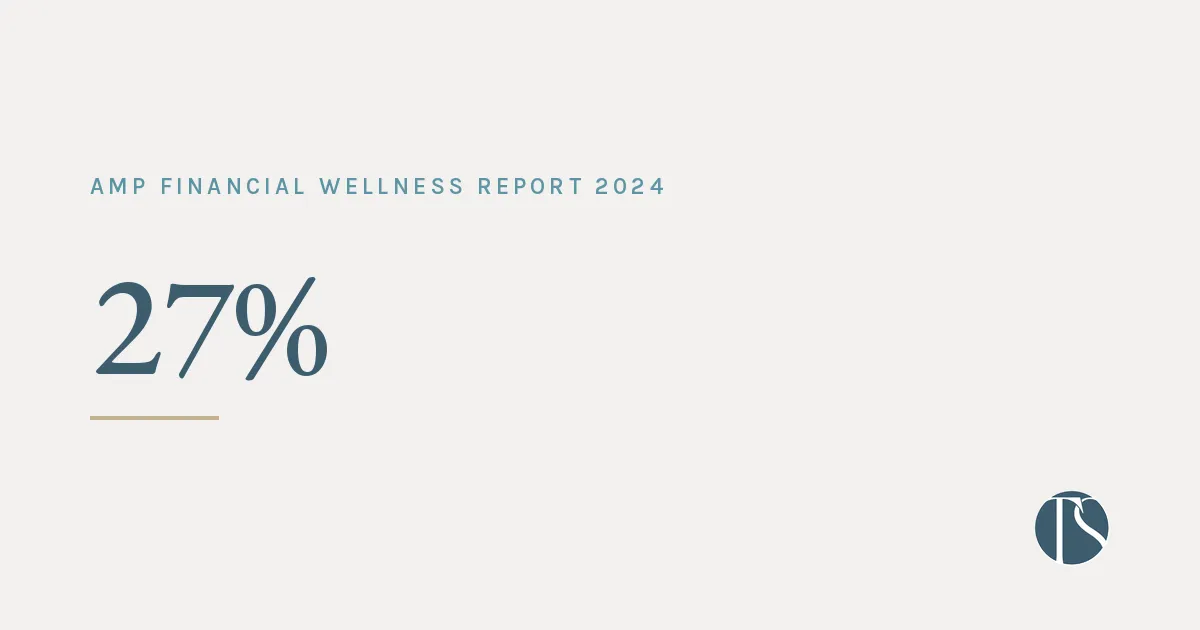
More than a quarter of Australians have told nobody
Your engagement survey is not measuring how many people are under financial pressure. It is measuring how many are willing to say so.
AMP’s Financial Wellness Report 2024 asked a question most workplace instruments never ask. More than a quarter of Australians - 27% - hold a financial worry or secret they have not shared with anyone at all.
Not their employer. Anyone.
The reasons matter as much as the number, and they are worth reporting in the order the research found them, of those holding a secret: embarrassment (48%), guilt (37%), a belief there is no need to share it (29%), anger (24%), and having nobody to share it with (23%). Fieldwork July 2024, n=2,475, post-weighted to ABS statistics. AMP provides banking, superannuation and advice services, which is worth knowing when you read their research.
That third reason is the one I would not skip past. Nearly three in ten say there is no need to tell anyone, which is a different thing from shame and probably the most honest answer on the list. Plenty of people are managing something privately because managing it privately is a reasonable adult decision. The finding is credible precisely because it is not all shame.
What this does to your data
Every instrument an organisation uses to understand its workforce depends on disclosure. The engagement survey. The pulse. The manager one-to-one. The EAP intake. The exit interview.
Each of those asks a person to say a true thing about themselves to an organisation that also controls their income.
Apply the 27% to that and the arithmetic gets uncomfortable. If a quarter of the population is carrying something they have not told their partner, their family or their closest friend, the proportion carrying something they have not told their employer is necessarily larger. Not by a little.
Which means the number you get back is not a prevalence estimate with some noise in it. It is a disclosure rate wearing a prevalence estimate’s clothing, and the gap between the two is invisible from inside the data.
The failure this produces
It runs in a predictable sequence, and I have watched it run in organisations that were doing everything else well.
The survey comes back and financial pressure does not feature - because there was no field for it, and because the people carrying it are the least likely to volunteer it in a form with their staff number on it.
The analysis reflects the survey. The strategy reflects the analysis. The budget reflects the strategy.
And a year later somebody asks why the wellbeing spend does not seem to be reaching the people it was meant for, and the honest answer is that nobody ever established who those people were.
The organisation did not ignore the problem. It measured, found nothing, and reasonably concluded there was nothing to find.
What changes it
Three things, and none of them requires anyone to identify themselves.
Ask, anonymously, at cohort level. The moment a response can be traced to a person, you are measuring courage rather than condition. Aggregate reporting with a floor on group size is not a nicety, it is the whole instrument.
Ask about the situation, not the person. “Do you have financial problems” invites a defensive answer. “Does money occupy your attention during the working day” is answerable without an admission, and it is closer to what you actually want to know, because attention is the thing your organisation is buying.
Then say what you found, out loud, back to the room. This is the part organisations skip and it is the part that does the work. A workforce that learns most of its colleagues answered the same way stops treating the topic as a private defect. Nothing else in the sequence changes as much for as little.
The thing worth sitting with
Concealment is not an incidental feature of financial pressure. For a large number of people it is the primary symptom, and it is the reason this particular driver stays invisible while others get named, budgeted for and managed.
Physical safety became measurable when reporting stopped costing people something. Mental health moved when the disclosure penalty dropped far enough that people would talk about it in a workplace.
This one is still where those were. The support you have built is not failing. It is waiting on a door that nobody has opened yet.
Find out whether you would currently see it
The Financial Pressure Pulse Check is twelve questions and about four minutes. It maps how much pressure is likely moving through your workforce against how well set up you are to see it, and gives you your position on both.
