They say curiosity killed the cat. Never met anyone responsible for a workforce it hurt.
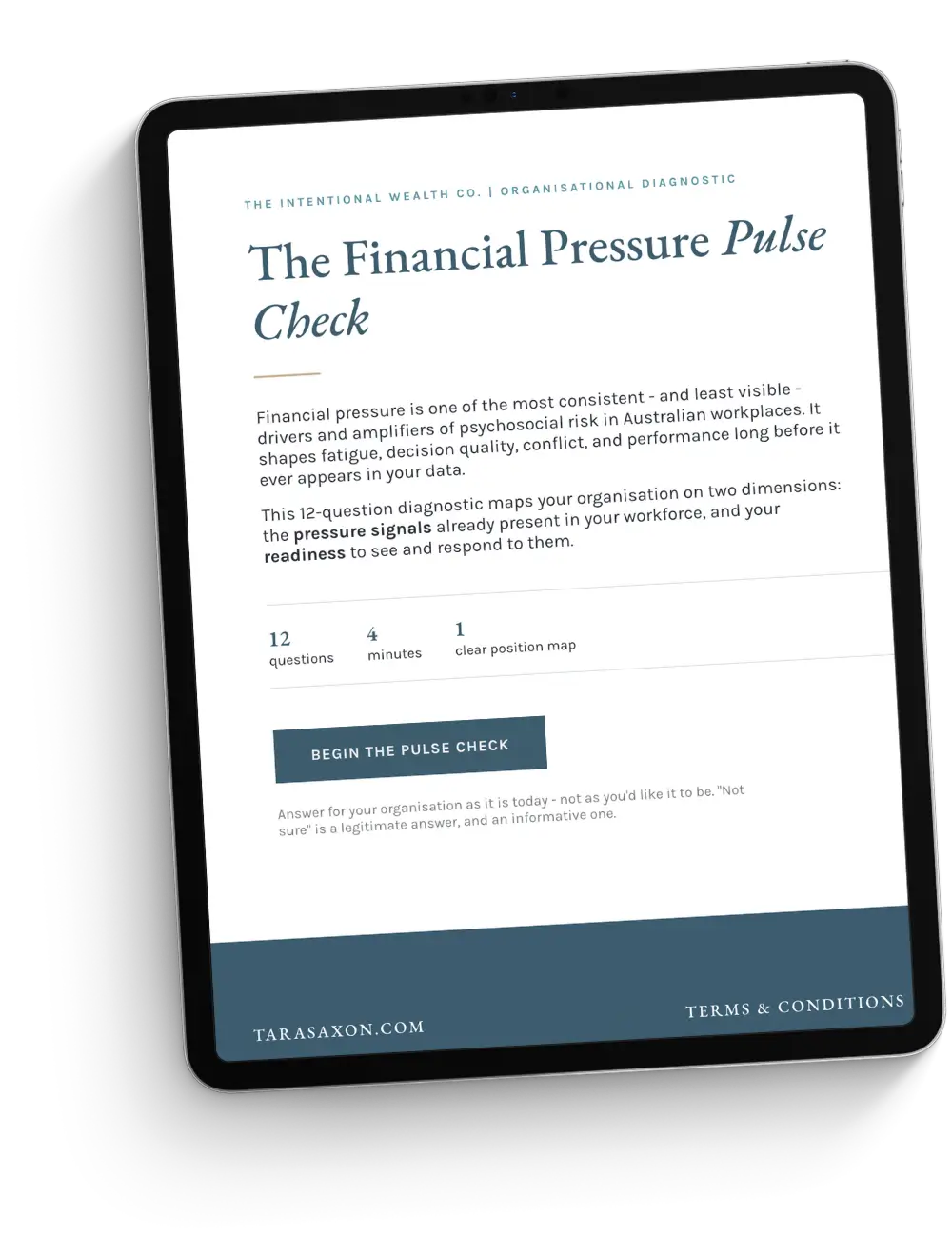
You track engagement, safety, attrition and pipeline. You've got no instrument for the pressure sitting under all four.
Four minutes, twelve questions. I'll tell you straight where you're sitting today - and a roadmap for doing something about it.
Who it's for: For the HR, safety, people and sales leaders who suspect the numbers aren't telling the whole story.
Free · 4 minutes · a position map you can take to your executive
See the pressure your people carry - even the ones who'd never say a word, and even if you've never had a way to lift the lid before.
Trying to work out why the numbers won't shift - why engagement dips in a team that's resourced fine, why your steadiest performer suddenly isn't, why the exit interviews keep saying "personal reasons"? Of course you are. You're good at this, and you already sense there's something moving underneath the data you've got. There is. It has a name, and once you can see it, you can act on it.
So here's what the Pulse Check actually is. Four minutes. Twelve questions. Not a survey, not a quiz, and not a way to win the argument with the person in the last leadership meeting who folded their arms and announced the organisation was completely fine. (Every leadership team has one.)
You answer honestly, and it maps your position on two axes:
how much financial pressure is moving through your workforce, and how well set-up you are to see it and do something before it does the deciding for you. No score out of a hundred. No traffic light going smugly green. A position - and the specific next move for exactly where you land.

And if you've never had a way to look at this -
that's not a hole in your leadership.
Nobody handed you one.
Financial pressure got waved off to the financial planners. Psychosocial safety got parcelled out to the wellbeing programs — good work, well funded, and aimed somewhere else entirely. (The bean bags and the aromatherapy diffuser might have made breakout rooms considerably more civilised than they were in 2005… but they were never going to reach this layer.) And the place where the two collide - the thing quietly draining your Thursday-afternoon focus, bending your best people's judgement, and writing resignation letters six weeks before anyone hands one in - has had nobody watching it.
I've spent two decades reading pressure inside banks and boardrooms; this is the instrument I built to catch it early. Consider it the shortest route from "something's off" to "here's exactly where we stand" - and it's yours, right now.
THAT'S THE X ON MY MAP. SO WHAT DO I ACTUALLY GET?
Here's what lands in front of you at the end of the four minutes - and in your inbox, ready to put to work:
Your position on the map
not a score, not a rating, but exactly where your organisation sits across two axes: how much financial pressure is moving through your people, and how ready you are to see it and act. One glance tells you whether you're in front of this or behind it.
Four domains, laid bare
visibility, acute pressure, the slower chronic patterning, and your readiness to respond, each broken out so you can see where the strength is and where the gap's been hiding. This is what turns "something feels off" into "right, that's where we start digging."
The read for your quadrant - including the one that catches everyone
a straight interpretation of where you've landed and what it means, with no dead ends and no "you're fine, off you go." Every position comes with a specific next step. A map that doesn't tell you where to walk is just a nice picture.
A lot to show for four minutes:

A read you didn't have to commission
no consultant, no six-week engagement, no invoice. Four minutes and a coffee.
The two-channel split most tools miss
it separates the acute pressure you can see from the chronic patterning you can't. Seeing them apart is half the insight.
A short series built around your exact result
over the following days, prompts and small moves matched to your quadrant. Things to act on this week, not file for later.
Language for the thing you couldn't name
sometimes the most valuable outcome isn't a score. It's finally being able to say out loud what's been niggling for months.
An artefact for the executive team
a position you can put in front of the people who hold the budget, in a form they'll take seriously. Evidence, not a hunch.
A picture built for your organisation, not the average
your sector, your workforce, your result. Nothing off a benchmark shelf.

WHO’S READING YOUR RESULTS?
I’m Tara Saxon
I trained as a classical musician before I ever read a balance sheet - which turned out to be the same skill in a different room. A trained ear doesn't follow the melody everyone's humming; it catches the note that's slightly off, the shift coming before it arrives, the instrument nobody's noticed is straining. I've been doing that ever since. I just changed what I was listening to.
What I changed it to was two decades inside banking and finance - Arthur Andersen, NAB, BankWest, American Express - where the job, whatever the label, came down to looking at what's in front of you and finding what the headline numbers hide. Risk that hasn't surfaced. Exposure nobody's named. I build the Pulse Check the same way: start with what everyone can see, then go looking for what they can't. The difference now is the subject - not the balance sheet, the people, and the financial pressure moving through a workforce long before it shows up anywhere official.
B.Com, Masters of Applied Finance, and the behavioural credential to match the commercial one - which is the whole point. Most people who understand the money can't read the human side, and most who read the human side have never sat in a budget meeting that mattered. This diagnostic exists because I do both.
And because, once I'd heard it, I could never quite un-hear it.
Fair warning: you're about to have the same problem.
Four minutes now, or the same four questions at 2am in six months' time.
(One of those comes with a position map and action steps. The other comes with a resignation letter you didn't see coming.)
You already sense there's something moving underneath your numbers. This tells you where you sit, what it means, and the one move to make next - free, in the time it takes your coffee to go cold.
Four minutes now, or the same four questions at 2am in six months' time.
(One of those comes with a position map and action steps. The other comes with a resignation letter you didn't see coming.)
You already sense there's something moving underneath your numbers. This tells you where you sit, what it means, and the one move to make next - free, in the time it takes your coffee to go cold.